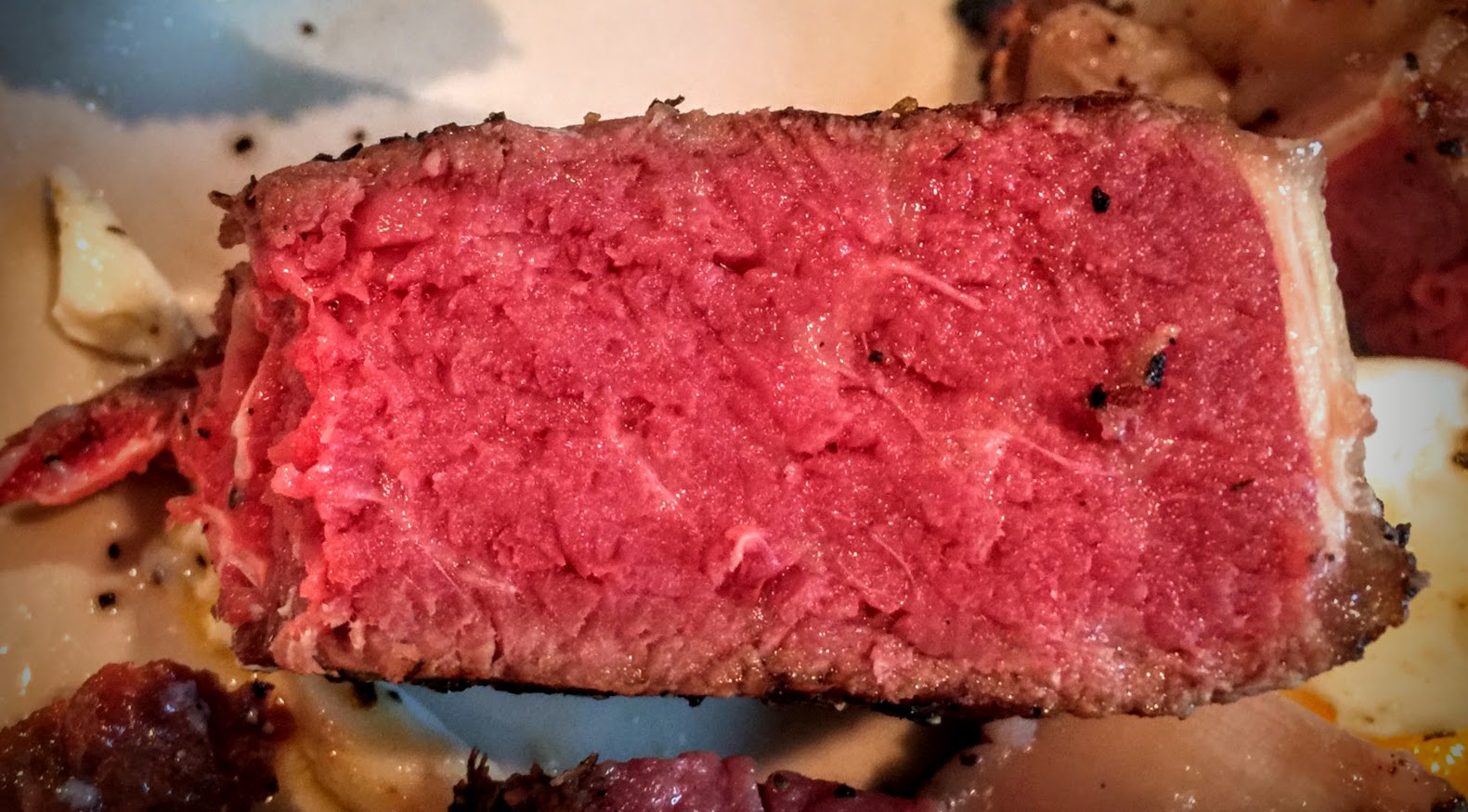
I got lucky and found a Prime Packer at Costco.

Here it is out of plastic vacuum home. I am going to remove all but a 1/4 of an inch of fat. I will save the extra fat for another project. Well, if you have to know, I plan on making a Pastrami Salame.


So my choices are to use Red Boat Fish Sauce at 3% or use the Red Boat Salt at 1%. Both products are amazing and produce near the same results (see this post for more info). Depending on the application, sometimes one is better than the other. In this application, I will be using the salt. After I trimmed up the Brisket, I was left with 4237 grams or 9.34 lbs of meat. Calculating the salt needed is easy too....4237 grams (meat) X 1% (salt) = 42.37 grams (salt needed). Anyhow smear on the salt getting it into all the nook and cranny.
After applying the Red-Boat Salt apply the rub.
 Here is my experimental rub. Why is it experimental? I haven't tried it yet. Drank a lot of water as I was putting this thing together, though. You can only measure the success of a good rub after the cook. The flavor profile is completely different before and after the cook.
If you haven't noticed by now, there is no added salt in the recipe except for the celery salt. That's because the Red-Boat Salt has plenty. If you plan on not using Red-Boat, you will need to increase the salt percentage.
Using the percentages in the recipe is as follows, but If you want a lot of details, CLICK HERE. I.e., After trimming the brisket, the green weight is, let's say 6000 grams. Oh, yea, before I forget to convert your pounds to grams. If you want to use pounds, knock yourself out, but it's not as precise or as easy. Anyhow take the meat weight 6000 grams X (Coarse Black Pepper) .30% (.003) = 18 grams.
This recipe is enough for the brisket and then some. You should have about 20% leftover, which you will use with maybe some more sugar for the smoke. When the brisket comes out of the SV bath, it will be wet, and some of the rubs will be lost in the liquid.
Note: Brown Sugar and Chipotle Percentages can be adjusted any way you like.
 I won't bore you with lots of details but suffice it to say the salt needs about 4-5 days to penetrate the whole brisket. This technique is called dry-brine. If you want a lot of details, click on the above links. Technically speaking, the salt is the only thing that will penetrate the meat because the salt molecules are smaller than the water molecules. Besides meat is about 75% water. Sugar ions are 10 X bigger than salt ions and really won't penetrate all that much. If salt takes 24 hours to penetrate an inch, how long would it take for sugar to do the same thing? Yea, I don't know either. Here is mine, however. I still like applying my rub during the dry-brine time because the rub will penetrate maybe 1/16 -1/8 inch according to Amazing ribs.com, and having done it both ways, that's my preference. Every micro inch counts in my book.

After applying the rub, I double vacuumed sealed the brisket. It will sit in the refrigerator for about 3-4 days. As of this writing, it sat there for about 3.25 days.

After the 3.25 days, the Brisket will be Sous-Vide at 104 f (Warm Aging) for 3 hours and 40 minutes (allowing 20 minutes to get up to 135 f). Once the SV reaches 135f, I will keep it there for 42 hours, which is 6 hours less than my previous BBQ Brisket Recipe.

All done....The Brisket will be Ice-Shocked and refrigerated for several days until I move on to the next step.


 I will be using my Modified Weber Smokey Mountain for the next step.
You are getting the fire ready. This customized grate is big enough to do a 22-hour smoke without every having to replenish the charcoal. The bricks in the center allow me to snake the charcoal, and the double size extra wide grate allows for very very long cooks. If you wanted to, you could place wood throughout the charcoal, and over time it would ignite providing extra smoke and flavor.

Brisket out of the vacuum-sealed plastic and ready for the next step.
 A lot of the rub rinsed off during the Sous-Vide, so I applied extra rub. I also used extra black pepper. Why? Because I like black pepper.
The pictures below speak to the next step. Before I put the meat on, I let the smoker SMOKE (190-225 f) for about 15 minutes. I wanted to wait till there were no flames, just ash. I used a wireless temp gauge too. I planned to smoke until it hit an internal temp of 145-150 f degrees.


All Done!!! Wrapped in foil to redistribute juices and I had to wait for all the sides get done. The brisket is cooked to an internal temp of 147 f.
Gratuitous Pictures below
Review- It came out great. The rub was good but nothing to write home about. The rub will need to be tweaked. The Faux Fish Salt was excellent. Unless you do a side by side compassion, there no way to tell if it made a difference, it tasted mighty fine though. The Warm Aging was easy to do, but was it worth doing? Not sure at this point. It tasted great and had great texture too at 42 hours.
The only regret is this..... I should have made Burnt Ends from the point.


 UPDATE-WARM-AGED AT 113F AT 3.5 HOURS. DID IT MAKE A DIFFERENCE? SO HARD TO QUANTIFY ON LONG COOKS. TOP OF THE FAUXTASTIC PAGE
After applying the Red-Boat Salt apply the rub.

If you haven't noticed by now, there is no added salt in the recipe except for the celery salt. That's because the Red-Boat Salt has plenty. If you plan on not using Red-Boat, you will need to increase the salt percentage.
Using the percentages in the recipe is as follows, but If you want a lot of details, CLICK HERE. I.e., After trimming the brisket, the green weight is, let's say 6000 grams. Oh, yea, before I forget to convert your pounds to grams. If you want to use pounds, knock yourself out, but it's not as precise or as easy. Anyhow take the meat weight 6000 grams X (Coarse Black Pepper) .30% (.003) = 18 grams.
This recipe is enough for the brisket and then some. You should have about 20% leftover, which you will use with maybe some more sugar for the smoke. When the brisket comes out of the SV bath, it will be wet, and some of the rubs will be lost in the liquid.
Note: Brown Sugar and Chipotle Percentages can be adjusted any way you like.


After applying the rub, I double vacuumed sealed the brisket. It will sit in the refrigerator for about 3-4 days. As of this writing, it sat there for about 3.25 days.

After the 3.25 days, the Brisket will be Sous-Vide at 104 f (Warm Aging) for 3 hours and 40 minutes (allowing 20 minutes to get up to 135 f). Once the SV reaches 135f, I will keep it there for 42 hours, which is 6 hours less than my previous BBQ Brisket Recipe.

All done....The Brisket will be Ice-Shocked and refrigerated for several days until I move on to the next step.


 I will be using my Modified Weber Smokey Mountain for the next step.
 You are getting the fire ready. This customized grate is big enough to do a 22-hour smoke without every having to replenish the charcoal. The bricks in the center allow me to snake the charcoal, and the double size extra wide grate allows for very very long cooks. If you wanted to, you could place wood throughout the charcoal, and over time it would ignite providing extra smoke and flavor.

Brisket out of the vacuum-sealed plastic and ready for the next step.
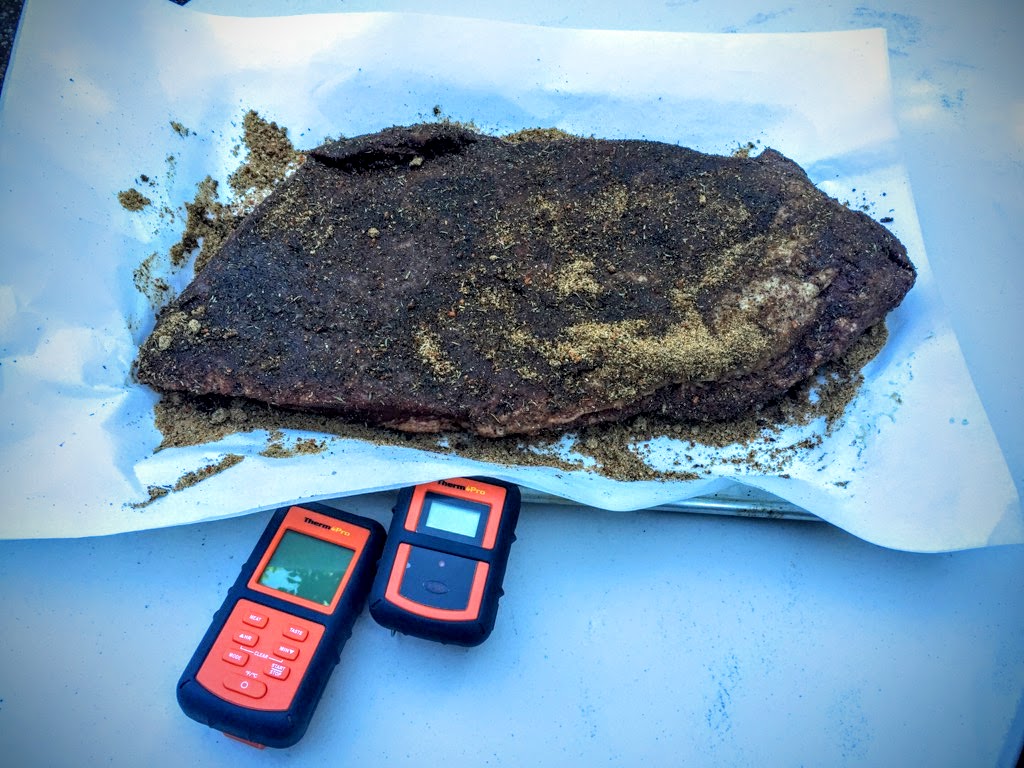
The pictures below speak to the next step. Before I put the meat on, I let the smoker SMOKE (190-225 f) for about 15 minutes. I wanted to wait till there were no flames, just ash. I used a wireless temp gauge too. I planned to smoke until it hit an internal temp of 145-150 f degrees.


All Done!!! Wrapped in foil to redistribute juices and I had to wait for all the sides get done. The brisket is cooked to an internal temp of 147 f.
Gratuitous Pictures below
Review- It came out great. The rub was good but nothing to write home about. The rub will need to be tweaked. The Faux Fish Salt was excellent. Unless you do a side by side compassion, there no way to tell if it made a difference, it tasted mighty fine though. The Warm Aging was easy to do, but was it worth doing? Not sure at this point. It tasted great and had great texture too at 42 hours.
Recap of what I did-
- Fish Salt Rub and regular rub applied 3.25 days in advance
- Sous-Vide at 104 f for 3 hours and 40 minutes
- Sous-Vide at 135 f for 42 hrs
- Ice-shocked and refrigerated
- Smoked between 190-225 to an internal temp of 147 f.
The only regret is this..... I should have made Burnt Ends from the point.